From TikTok followers to weekly Quran students
How Quran teachers get students on TikTok and Instagram: what to post, the adab of recitation clips, what Lives are for, and how a follower books a lesson.
7 min read
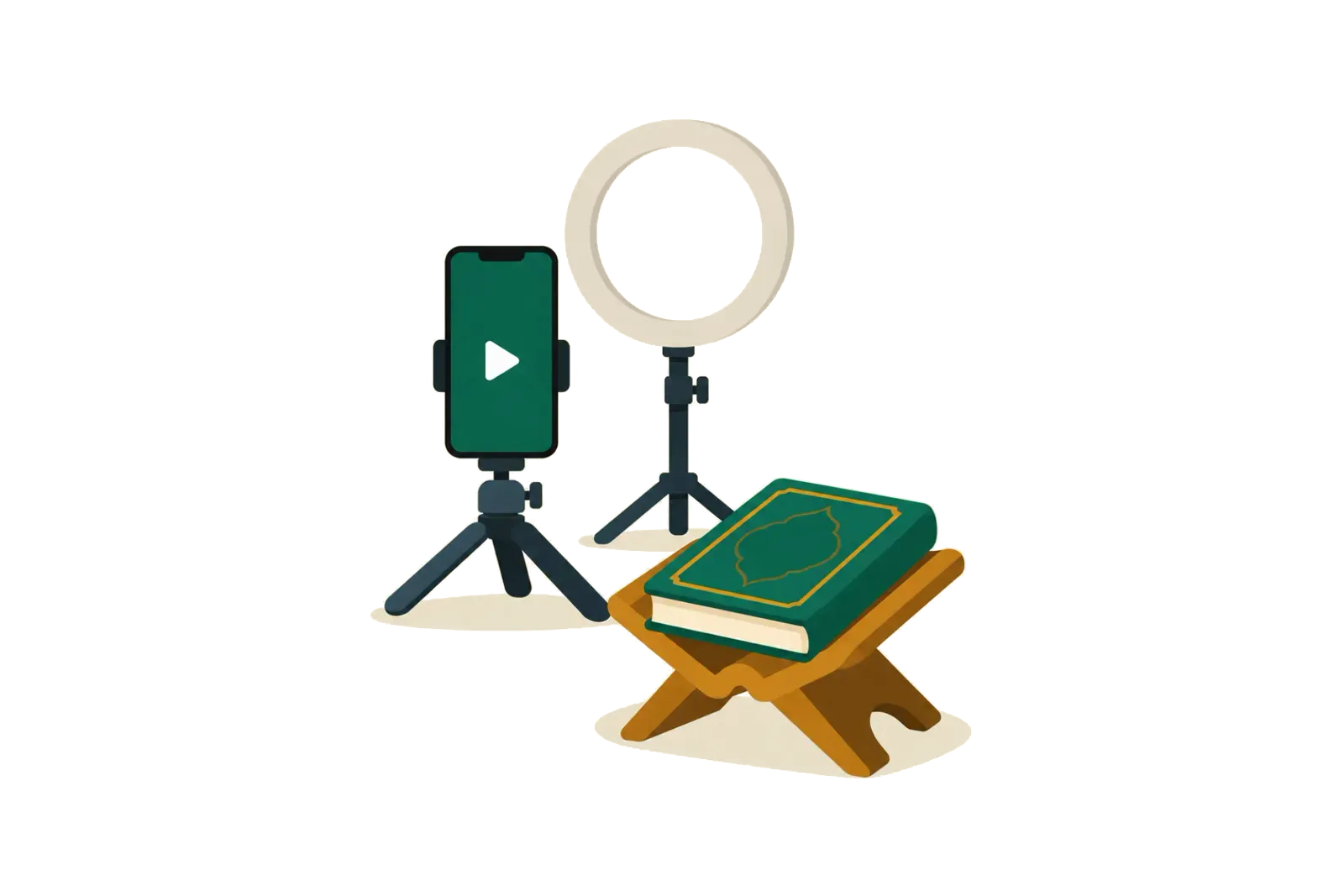
Many Quran teachers now find their students on TikTok and Instagram. A short video of one tajweed rule on one word reaches people a flyer at the masjid never would. Most of those viewers never book a lesson, though, and the ones who do usually follow the same path: they watch, they ask a question, they try one lesson, and they come back.
This guide is about that path, from a video someone watches to a lesson they book every week.
Fewer people reach each step. That’s normal, and it’s why each step should be small.
1The clip
They
Watch one rule on one word, maybe twice.
You
Show how you correct: one rule, one word, the sound before and after. Your own recitation.
Can TikTok be used to teach Quran?
TikTok is good for reach: it shows your teaching to people who don't know you yet. It is not a good place for the lesson itself. You can't see the same mushaf page as your student, you can't mark a word, and there's nothing left afterwards for them to practise from.
Think of TikTok and Instagram as the door, and the lesson as the room.
What should Quran teachers post?
Post short, specific clips that show how you teach. One rule, one word, one correction. People decide whether to learn from you by watching you explain something they got wrong.
Ideas that tend to get questions:
- One tajweed rule shown on one word, with the sound before and after.
- A common mistake in Al-Fātiḥah and how to fix it.
- How you test memorisation: hiding the words and asking for the next ayah.
- What a first lesson with you looks like, start to finish.
- A short answer to a question someone asked in your comments.
Keep your own recitation in the clips, not your students'. If you ever want to show a student, ask them first, only feature adults, and make the clip on its own, outside the lesson. Lessons on Quraniya are live and never recorded, so nothing from a real lesson can end up online.
Timing matters too. Clips posted through Rajab and Sha'ban are already up when adults start looking for a Ramadan teacher; how to find Quran students before Ramadan sets out the weeks.
What adab should Quran clips keep?
The same adab as the lesson. A clip is still the Quran, and the people who will trust you with their recitation are watching how you treat it.
- No music under recitation, and no trending sounds over an ayah.
- Recite it correctly. Check the clip before posting; a slip in a teaching video teaches the slip.
- Keep the Quran out of jokes and trends, even when a format is doing well.
- Show the mushaf with care: on a stand or a clean surface, not on the floor.
- Your face is your choice. Some sisters teach with voice and hands only, the mushaf in frame. It shows how you teach just as well.
A clip that teaches the slip
Five rules at once. Nobody learns one, and nobody asks about one.
A clip that teaches
One rule on one word, the sound before and after. It invites “do I do that?”
What are Lives good for?
Lives are for reach and questions, not lessons. A weekly Live where you go through one rule and answer questions shows people how you teach, in real time, and gives them a reason to follow.
To go Live on TikTok, you must be at least 18, and your account needs a certain number of followers, which varies by market. If you can't go Live yet, a short video answering one question does a similar job.
End each Live the same way: say where to book a first lesson.
How do you turn a follower into a student?
Give them one clear next step, and make it small. A follower who has to message you, agree a time, find a link and work out how to pay will often stop halfway.
- One link on your profile. Instagram lets you add a website to your profile. Point it at one page where someone can book or send a first message, not at a list of ten links. TikTok doesn't offer a clickable profile link to every account, so some teachers point TikTok viewers to their Instagram instead.
- A first-lesson offer. Say plainly what the first lesson is, how long it lasts, and what it costs, even if it's free.
- A reply you can send in seconds. When someone asks "how do I start?", have a short answer ready with the link.
- A fixed time. Offer two or three slots rather than "whenever suits you".
Should followers message you on WhatsApp?
It's the channel most teachers' clips point to, and it works because everyone has it. A WhatsApp link to your number (wa.me followed by your number) opens a conversation with you in one tap, and you can add a message so the follower doesn't have to think of one, such as "Assalamu alaikum, I'd like to try a first lesson."
Two cautions. A public number gets messages at all hours, so set times when you reply and say so. And keep the booking and payment out of WhatsApp where you can: a message thread is a poor place to track who has paid for what.
Is a group class a good first step?
Yes, for many followers. Joining a group lesson with other adults feels like less of a commitment than booking a teacher one to one. They can listen first and recite when they're ready.
On Quraniya you can run free group classes for up to 10 learners and invite them with a link. Everyone reads from the same mushaf page as you. Paid group classes aren't open yet, so use the group class as the step before one-to-one lessons, not as the paid lesson itself. The create a class guide shows the setup in a short video.
What does the first real lesson need to show?
The first lesson has to feel different from the videos. In a video they watched you correct someone else. In the lesson, you correct them, on their own page, and they leave knowing what to practise.
On Quraniya you mark the exact word that needs work with its tajweed rule (the create a class guide shows how), mark each ayah as recited, memorised or needs work, and after the lesson you score it and can leave a short note. Your student keeps a recap of what you marked, which gives them something to do before your next lesson. It also gives you a reason to book that next lesson.
How do you keep them coming back?
Set the next lesson before this one ends. Students who leave without a time often don't come back, not because they lost interest but because nothing was booked.
- Agree a weekly time, the same day and hour if you can.
- Point them to one thing on their recap to practise.
- Open the next lesson with that thing, so practice pays off straight away.
- When they're ready, suggest a plan: 4, 8 or 12 lessons every four weeks.
A simple weekly routine
You don't need to post every day. A steady routine you can keep matters more than volume.
Your posting week
Getting paid once they book
Followers who become students need a simple way to pay, or you end up chasing transfers. When students book and pay through Quraniya, they pay your price with nothing added, Quraniya keeps 15% including card fees, and each lesson's earnings become transferable 7 days after it's taught. Paid lessons are open to teachers who live in the UK, Ireland or the US, for adult students. See getting paid without chasing anyone and how much to charge.
If you already have followers asking how to learn with you, start with one: invite them to a free group class or a first lesson, and see how it goes. The teacher page has everything else, and there are more ideas in how to find Quran students online.
Other product names on this page (WhatsApp) are trademarks of their owners. Quraniya is not affiliated with them.